find your perfect postgrad program
Search our Database of 30,000 Courses
Masters Degree in Archaeology
Although earning an undergraduate degree in archaeology can open up various doors in terms of career options, the subsequent completion of a postgraduate degree significantly improves employment prospects.
Studying a Masters in Archaeology allows people who have studied other subjects at undergraduate level to study archaeology at postgraduate level, and can assist with entry into some archaeology and heritage-based jobs, as well as serving ideal preparation for a PhD in the subject. In addition, it is helpful for those moving into numerous other vocations where project management, literacy and research skills are important attributes.
In order to study archaeology at masters level, students must first complete an undergraduate degree in archaeology, or in an associated field or another social science, such as history, geography or even some science subjects. Most universities require students to have at least a 2:1 at undergraduate level, although entry requirements vary between different academic institutions and should be checked individually.
A full-time archaeology masters degree can be completed over the course of one academic year, while students studying on a part-time basis will usually take two years to finish the course. In some instances, a third year of study may be required.
Masters degrees in archaeology can either take a research focus or a vocational focus. If the degree is research-based, an emphasis will be placed on written work, while if it is more vocation-based, it will typically place a focus on practical elements, such as field work.
Areas of specialisation
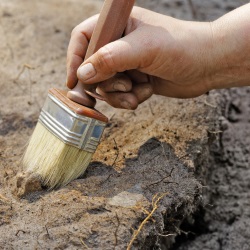 In the majority of cases, a Masters in Archaeology is made up of two core modules, six optional modules and the completion of either a written dissertation or a field-based work placement. With that said, different universities may structure their particular archaeology course slightly differently. The core modules and optional modules available vary drastically, but will often include:
Archaeology Theory
Fieldwork Skills
GIS for Archaeologists
Heritage & History
Data Analysis
Conservation
Whether the masters degree requires the completion of a dissertation or a work placement depends upon whether the degree has a research or vocational focus. Some archaeology courses will offer students a choice between the two pathways, while others have a set focus for all students on that particular course.
Most students studying archaeology at masters level will graduate as a Master of Arts (MA) or a Master by Research (MRes). However, some archaeology masters, including forensic archaeology degrees, will instead result in the graduate becoming a Master of Science (MSc).
Specialist archaeology masters courses
In addition to more general archaeology masters degrees, a number of more specialist masters degrees can be found, including:
Medieval Archaeology – focuses on artefacts, buildings and material culture from the medieval time period.
Maritime Archaeology – the study of underwater archaeology, such as shipwrecks and submerged settlements.
Anthropological Archaeology – understanding past human life through uncovering material evidence.
Landscape Archaeology – deals with the historical interaction between humans and their environment.
Forensic Archaeology – Contains elements of both the study of archaeology and the study of forensics.
Universities offering specialist masters degrees in archaeology
Many universities in the UK offer specialist masters degrees in archaeology. For example UCL (University College London) offers many different masters degrees in this field, Archaeological Science: Technology and Materials, Archaeology, Archaeology and Heritage of Asia, Archaeology and Heritage of Egypt and the Middle East, Computational Archaeology: GIS, Data Science and Complexity, Conservation for Archaeology and Museums, Environmental Archaeology, and six more options.
Student case studies
1.“My postgraduate research project centres on a group of objects from our own Garstang Museum, which I am cataloguing, analysing and researching with the aim of garnering a better understanding of the tomb they are from and early Ancient Egypt in general. I am really enjoying being responsible for my own progress, and for the nature and structure of my work.”
Hayley Meloy, MA Archaeology, University of Liverpool.
3. “After studying ancient history and archaeology at undergraduate level, I wanted to progress in my studies to further my knowledge in the archaeology industry. The main thing I like is the one-to-one tuition which you get from the lecturing staff. They have wealth of knowledge in their subject areas and this is a great help at this level.”
Claire Burns, MSc Archaeology and Environment, Queen's University Belfast.
Career opportunities for graduates of achaeology
After studying a Masters in Archaeology, graduates will have developed or enhanced their research, literacy, project management, teamwork and analytical skills, making them ideal candidates for a number of jobs where those attributes are desired. In terms of careers related directly to the course, archaeology masters graduates should be sufficiently equipped to go into museum and national heritage-based vocations and some lower end archaeology jobs. Moreover, the course serves as ideal preparation for further study, such as an archaeology PhD, which can lead to careers at the top end of the archaeology industry. A masters degree can also function as a good building point for careers in lecturing or teaching.
Careers in this field include:
- Field archaeologist – carrying out excavations and surveys
- Heritage consultant – advising on planning, conservation and development
- Museum curator – managing and interpreting artefacts
- Conservator – preserving archaeological materials
- Archaeologist outreach officer – engaging communities and schools
- Environmental or planning consultant
- Policy or advisory roles – in government or NGOs
Related articles
Top 10 Heritage Studies Masters Degrees In The UK
